
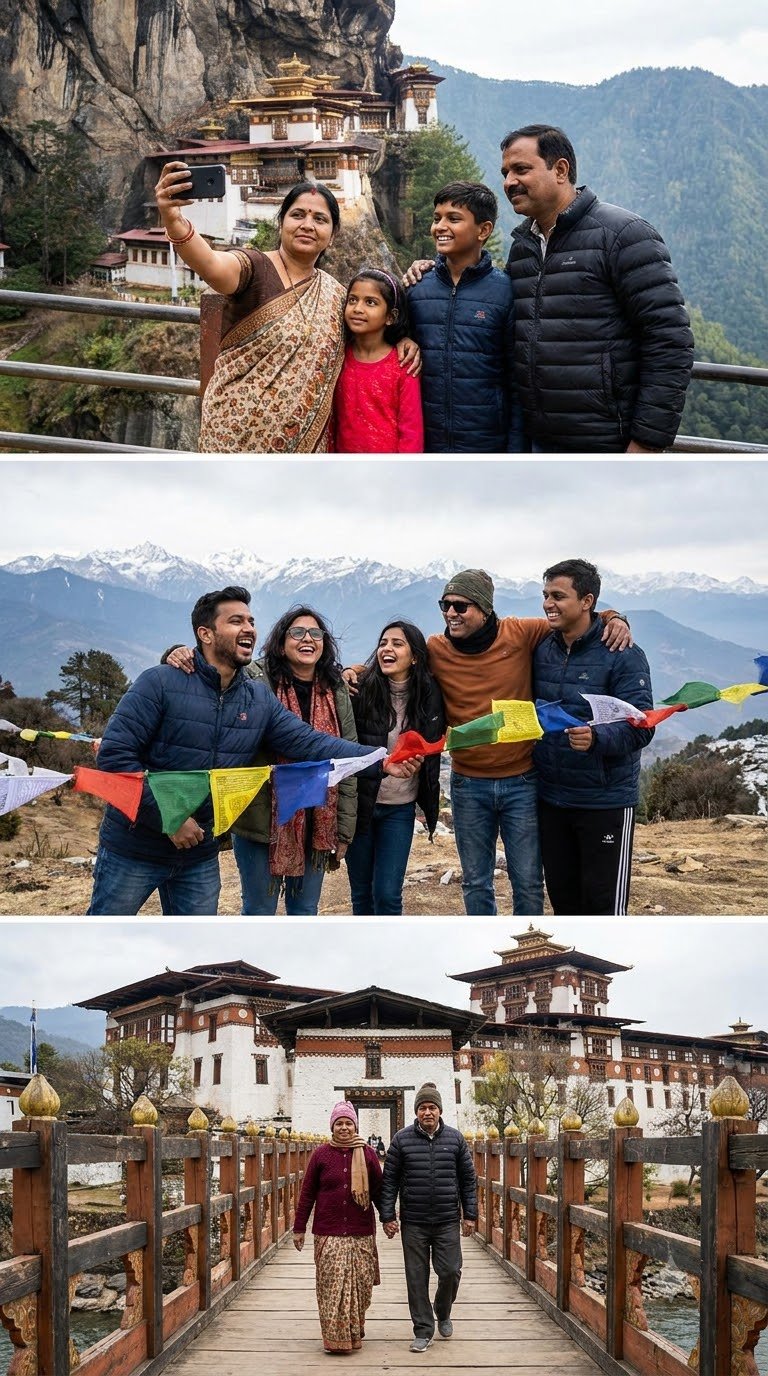
Most of what you will visit on a Bhutan 4 star cultural tour is still being used for the purpose it was built for. The dzong in Thimphu is a working government office and a monastery at once. The prayer wheel beside the road is spun by someone on the way to buy vegetables. Schoolchildren walk to class in the national dress. That is what separates a cultural tour here from a museum circuit, and it is also why a rushed one disappoints: the best moments tend to arrive in the gaps between the famous sights.
The four-star part of the name is a practical choice rather than an extravagant one. Days that start with a monastery at dawn and end after a long mountain drive go better when the room waiting at the end of them is warm, quiet and has hot water you can count on. What follows covers what the label does and does not promise, which valleys earn a night of your time, how to pace the days, and when a festival can make or break a trip. Costs depend on season, hotel category and group size, so ask for a written quote for your own dates instead of relying on a generic figure.
A Bhutan 4 star cultural tour is a guided, private-vehicle journey that spends its days on dzongs, temples, museums, craft institutions and, when dates allow, festivals, and its nights in four-star-category hotels. Most travellers choose six to ten nights across Paro, Thimphu and Punakha, adding Phobjikha, Trongsa and Bumthang for a deeper trip. The guide, vehicle, permits, Sustainable Development Fee and daily breakfast and dinner are normally bundled in, while entrance fees and lunches usually are not.
What "Cultural" Actually Means on a Bhutan Tour
Culture in Bhutan is not a side activity layered onto a holiday; it is how the country organises itself. Its tourism approach has long favoured fewer visitors who stay longer and engage more, and a cultural itinerary is the most direct expression of that idea. In practice it rests on six strands, and a well-built tour weaves several of them into each day instead of saving every one for its own afternoon.
Dzongs
Fortress-monasteries that also run the district. Step through the main gate and you are in a courtyard shared by monks, officials and visitors. The wooden balconies, central tower and painted beams reward slow looking.
Lhakhangs and monasteries
From tiny village chapels to founding temples. The murals repay a good guide: once you can tell the Buddha from Guru Rinpoche from a protector deity, the dark interiors stop being a blur of colour.
Chortens, mani walls and flags
The roadside architecture of faith. Stupas, long carved stone walls and strings of flags at the passes, with five flag colours standing for sky, air, fire, water and earth.
Living arts
Thirteen traditional crafts, from thangka painting to paper making, are still taught and practised. Watching students at work in Thimphu stays with you longer than any display case.
Festivals
Tshechu festivals fill dzong courtyards with masked dances and villagers in their best clothes. If your dates can bend towards one, it will probably become the best day of the trip.
Everyday life
Farmhouses, weekend markets, archery matches, shared meals. Arranged visits are warm rather than theatrical, and the archery and market mornings happen whether you are there or not.
A useful test for any itinerary: pick a day at random and ask which strands it touches. If the answer is only "dzong, dzong, dzong", you are looking at a sightseeing list, not a cultural tour.
What Four-Star Really Means in Bhutan
A star rating in Bhutan tells you about standard, not style. Four-star properties are comfortable and well run, but they are not international chains, and the experience shifts from valley to valley. One quietly lovely side effect of the country's building rules is that new construction, hotels included, is expected to follow traditional architecture, so even a modern four-star hotel usually comes with carved window frames, painted eaves and a view you would photograph anyway.
The stay matters more on a cultural tour than on most trips. Dzongs and temples are best seen at quieter hours, you will often leave early and return after dark, and a comfortable base close to the centre of town shortens those days. Here is how to read the label.
What four-star usually gets you
- A private room with an attached bathroom and reliable hot water
- Heating in the cooler months, which matters far more here than air-conditioning
- A restaurant serving set or buffet dinners with Bhutanese, Indian and continental choices
- English-speaking front-desk staff who can sort out laundry, wake-up calls and packed breakfasts
- Traditional-style architecture and, often, a valley view
- Clean, comfortable common areas to rest in between sites
What the label does not promise
- A lift or ground-floor room in every property; ask if mobility is a concern
- Air-conditioning; lower, warmer valleys such as Punakha are where it is most worth asking about in summer
- A swimming pool, spa or round-the-clock kitchen
- The same standard in every valley
- A room facing the dzong or the valley; you can request one, but nobody can guarantee it
The honest caveat is geography. Paro, Thimphu and Punakha have the deepest choice of four-star hotels. Further east, in Trongsa and Bumthang, and in the Phobjikha valley, rated four-star options are thinner on the ground. The sensible approach there is to book the best available hotel in that valley rather than chase a label that barely exists. A good operator will tell you plainly which nights fall into that category; if yours does not, ask.
Valley by Valley: Where a Cultural Tour Spends Its Nights
Not every valley deserves the same number of nights. The table gives a quick overview, and the short notes below explain what each stop is really for.
| Valley | Heritage worth planning around | Nights that do it justice | Four-star availability |
|---|---|---|---|
| Paroabout 2,200 m | Kyichu Lhakhang, Rinpung Dzong, Drukgyel Dzong ruins, the Tiger's Nest hike | 2 nights, or 3 if it is also your departure night | Wide choice |
| Thimphuabout 2,300 m | Tashichho Dzong, Memorial Chorten, Changangkha Lhakhang, Textile and Folk Heritage museums, the craft institute | 2 nights | Wide choice |
| Punakhaabout 1,250 m | Punakha Dzong, Chimi Lhakhang, Khamsum Yulley Namgyal Chorten | 1 night at minimum, 2 for an unhurried visit | Good choice |
| Phobjikhaabout 3,000 m | Gangtey Monastery, valley-floor nature trail, crane habitat in winter | 1 night | Limited; best available |
| Trongsaabout 2,200 m | Trongsa Dzong, the Tower of Trongsa museum | 1 night | Limited; best available |
| Bumthangabout 2,600 m | Jambay, Kurje and Tamshing lhakhangs, Jakar Dzong | 2 nights | Limited; best available |
Altitudes are approximate and are included to help you plan for the cooler nights and the pace of the first day.
Paro: a first chapter that rewards slowness
Paro is where most journeys begin, and it makes a strong cultural opener because everything sits close together. Kyichu Lhakhang, among the oldest temples in the country, rests on the valley floor and is usually calm in the late afternoon. Rinpung Dzong is reached over a covered wooden bridge, and the walk across is half the pleasure. The Tiger's Nest hike gets the headlines, but the roofless walls of Drukgyel Dzong, left that way by a fire, are a better place to understand why these buildings stand where they do: they were built to guard the routes.
Thimphu: tradition and the modern state side by side
Thimphu is the best place on any cultural tour to see heritage and the working country sitting together. Tashichho Dzong holds both the throne room of the King and government offices, which is why visitor access is limited to certain hours and why your guide will time the visit for you. In the same afternoon you can watch students at the Institute for Zorig Chusum spend years learning painting and carving, then stand in the Textile Museum and see what a single backstrap loom can produce. At dusk the Memorial Chorten fills with older residents making their daily circuits. It is one of the few places where the right thing to do is simply stand and watch.
Punakha: the warm valley with the finest dzong
Punakha is lower, warmer and greener than the valleys on either side, and its dzong, built where two rivers meet, is arguably the most photogenic in the country. Chimi Lhakhang is a fertility temple connected with Drukpa Kunley, an unorthodox saint from the 15th and 16th centuries. The short walk to it through rice fields is what most visitors remember best. Khamsum Yulley Namgyal Chorten, higher up and a longer walk, is worth the effort for its detailed interior paintings.
Phobjikha, Trongsa and Bumthang: where Bhutan changes pace
East of the Pele La pass the country feels different. Phobjikha is a wide glacial valley with Gangtey Monastery on its ridge and black-necked cranes wintering on the floor. Trongsa Dzong, the largest in Bhutan and the ancestral seat of the royal family, spills down a ridge in a way photographs never quite capture. Bumthang, a cluster of four valleys, holds some of the oldest and most revered temples in the country, including Jambay and Kurje. Roads here are slower and hotels simpler, which is exactly why these valleys feel so unspoilt, and why they need unhurried days.
Bhutan 4 Star Cultural Tour Itineraries Compared
The three trails below put heritage first and driving second. All use four-star-category hotels, with the caveat above for the eastern valleys. Each can be shifted to land on a festival, slowed down, or extended with a nature day or a short trek once your operator knows who is travelling and when.

Western Heritage Trail
Essential6 Nights / 7 Days · Paro · Thimphu · Punakha
- Tiger's Nest, Kyichu Lhakhang and Rinpung Dzong across two unhurried Paro days
- Thimphu's museums and craft institute alongside Tashichho Dzong and the Memorial Chorten
- Dochula's 108 chortens and Punakha Dzong at the river confluence
- A final Paro night near the airport, so departure day stays calm
Best for: first-time visitors who want the core of Bhutan's heritage in about a week, and anyone short on leave.
See the day-by-day plan

Heartland Heritage Trail
Deeper8 Nights / 9 Days · Paro · Thimphu · Punakha · Phobjikha
- A full second day in Punakha, with Khamsum Yulley Namgyal Chorten and the long suspension bridge
- Gangtey Monastery and the Gangtey Nature Trail in Phobjikha
- Black-necked crane season between late autumn and early spring
- A built-in open day that absorbs delays instead of passing them on
Best for: travellers who prefer a relaxed rhythm, or who have already seen the western circuit and want a quieter valley.
See the day-by-day plan

Valleys of Faith Journey
Immersive10 Nights / 11 Days · Paro · Thimphu · Punakha · Trongsa · Bumthang · Phobjikha
- Trongsa Dzong, the largest in Bhutan, and the Tower of Trongsa museum
- Jambay, Kurje and Tamshing lhakhangs in Bumthang, among the most revered temples in the country
- Two nights in Bumthang with a full day for the temples
- High-pass road days past the Nepalese-style Chendebji Chorten
Best for: culture-focused travellers with time to spare, and anyone planning around Bumthang's autumn festival.
See the day-by-day plan
Hotels in Phobjikha, Trongsa and Bumthang are the best available in their category, so ask for the property name for every night. Every trail can be adjusted once your operator knows your dates, ages and interests.
Festivals and the Right Season for a Cultural Tour
A festival can lift a cultural tour from very good to unforgettable, and it can also reshape it, because hotels in the host valley fill early and roads get busy. The calendar below shows the months in which the main festivals usually fall.
Festival windows across the year
Shaded months show when each festival usually falls. Exact dates follow the Bhutanese lunar calendar and move every year.
If your dates are flexible, pick the festival first and build the trip around it. If they are not, the seasons still shape the experience. Spring, from March to May, brings rhododendron blooms and mild days. Autumn, from September to November, is the clearest time of year, with sharp mountain views from Dochula and the high passes. Winter is cold in the higher valleys but sunny and calm, and it is the time for the Phobjikha cranes and for having temple courtyards almost to yourself, while Punakha stays pleasantly warm. The monsoon months of June to August are green and uncrowded, with a higher chance of road delays, which is why the long eastern trail is best kept for the drier seasons.

Etiquette That Makes the Day Smoother
Bhutanese hosts are patient with visitors, and your guide will quietly steer you through every doorway. Still, knowing the basics beforehand means you spend your attention on the place instead of worrying about the rules.
Dress for the doorway
Shoulders and knees covered, no shorts or sleeveless tops at dzongs and temples. Light layers also cope with the altitude and the swing between cool mornings and warm afternoons.
Hats off, shoes off
Remove hats, caps and sunglasses before entering a temple, and leave shoes at the door. Slip-ons save a lot of fiddling on a day with several stops.
Cameras and monks
Photography is generally not allowed inside shrine rooms, though courtyards and exteriors are usually fine. Ask before photographing monks or anyone at prayer.
Walk clockwise
Circle chortens, mani walls and temples clockwise and turn prayer wheels clockwise too. Your guide will point out the direction the first time.
Offerings the easy way
A small note left at an altar or a butter lamp offering is the usual gesture. Your guide will show you where and how, so you are never guessing.
Quiet hands and feet
Do not touch murals or statues, step over temple thresholds rather than on them, keep feet from pointing at altars, and stay quiet during chanting.
Behind these habits sits Driglam Namzha, the traditional code of conduct. Nobody will quiz you on it, but a little effort goes a long way, and you will notice that people respond to the gesture more than to perfect execution.
What to Eat, and What to Bring Home
Lunch is usually not part of the package, and that is a gift. It means stopping where your guide recommends, in small restaurants that serve what locals actually eat. Ema datshi, chillies cooked in cheese, is the national dish and hotter than most first-timers expect, so ask for it mild. Kewa datshi, made with potato, is a gentler introduction. Red rice, momos and butter tea round out the staples, and in Bumthang look for buckwheat pancakes. Hotel dinners include Indian vegetarian dishes as a matter of course, and Jain or other dietary needs are best flagged to your operator in advance.
For things to carry home, handwoven textiles are the standout. A single piece of kira cloth can take weeks or months to weave, and the Textile Museum in Thimphu will teach you to tell a good one from a machine-made copy. Thangka paintings, handmade paper and carved masks are the other worthwhile choices. Genuine antiques and religious objects cannot be taken out of the country, so buy from shops your guide recommends and keep your receipts.
A Short Glossary for Your Trip
A handful of words come up every day on a cultural tour. Learn these nine and the signboards, your guide's commentary and the festival programme all get easier to follow.
Dzong
A fortress-monastery that houses a monastic body and the district administration under one roof. Every major valley has one.
Lhakhang
A temple or shrine, ranging from a single-room village chapel to a major founding site.
Chorten
Bhutan's form of the stupa, a monument holding sacred relics or texts, circled clockwise as an act of devotion.
Tshechu
An annual festival honouring Guru Rinpoche, held over several days in a dzong or temple courtyard and centred on masked dances.
Cham
Sacred masked dances performed by monks and trained laymen. Each dance carries a meaning, often a blessing or the subduing of harmful forces.
Thongdrel
A huge embroidered thangka unfurled for a few hours before dawn on the last day of certain festivals. Viewing it is said to cleanse the viewer of wrongdoing.
Gho and Kira
The national dress: a knee-length robe tied at the waist for men (gho) and an ankle-length wrapped garment for women (kira).
Zorig Chusum
The thirteen traditional arts and crafts of Bhutan, including painting, wood carving, weaving, paper making and metal casting.
Driglam Namzha
The traditional code of conduct that shapes how people dress and behave in sacred and official spaces.
What's Included in a Bhutan 4 Star Cultural Tour
Bhutan's tourism policy fixes a basic structure for every visitor, so the core inclusions look broadly similar across operators. What is worth confirming for a cultural tour is the hotel category night by night, the cultural focus of the guide, and exactly what sits outside the package.
Inclusions
- Accommodation in four-star-category hotels, with the best available category in remote valleys
- English-speaking licensed guide with a cultural focus
- Private vehicle with driver for the whole journey
- Driver allowance and parking fees
- Airport or border pick-up and drop-off
- Sustainable Development Fee
- Entry Permit and Route Permits
- MAP meal plan (breakfast and dinner)
- Complimentary SIM card and mineral water per room
Exclusions
- All entrance fees and monument fees
- Personal expenses
- Airfare or train tickets
- Lunch
- Any expenses arising from unforeseen circumstances such as landslides or flight delays
Permits, Visa and Documents
Indian nationals do not need a Bhutan visa, which is one reason so many cultural travellers come from India. There is still a short paperwork trail for each person in the group, and the detail that surprises first-timers is that the standard Entry Permit covers only Paro and Thimphu, so anywhere further needs a second document.
- Valid photo ID for every adultA passport with six months' validity, or a voter ID card for adult Indian nationals. Children can travel on a passport or birth certificate; carry the original, not a photocopy.
- Entry PermitFree, applied for online, and arranged by your operator as one group booking once the tour and dates are confirmed.
- Route PermitNeeded for Punakha, Phobjikha, Trongsa, Bumthang and other areas beyond Paro and Thimphu. Also arranged by your operator.
- Passport-size photographsA couple of spares per traveller, in case a physical form is needed at a border crossing.
- Basic medical kit and regular medicationWorth carrying a few extra days' supply, particularly once you are past Thimphu where pharmacies thin out.
- Travel insuranceNot mandatory for Indian nationals but sensible, especially for long mountain-road days and for anyone with a health condition.
You enter either by air or by road. Flights to Paro operate from New Delhi, Kolkata, Guwahati and Bagdogra, and the descent into the valley is a memorable start. Overland entry is through Phuentsholing, Gelephu or Samdrup Jongkhar, which suits travellers already in North Bengal or Assam. Your guide and driver meet you at either.
Ask for confirmation that both the Entry Permit and the Route Permits cover every traveller before you leave home. It is the easiest detail to fix early and the most frustrating to discover at a checkpoint.
How to Choose a Bhutan 4 Star Cultural Tour
Plenty of itineraries advertise culture; far fewer are built for it. Seven questions tend to separate the two.
- Ask for the hotel list night by nightRequest the named hotel and its category for every night. A trustworthy operator will tell you plainly where a night is the best available in a remote valley rather than formally four-star.
- Find out who the guide isA licensed guide with real cultural knowledge changes everything: ask how long they have guided, which sites they know best, and whether they can speak to the stories behind the murals as well as the dates.
- Check the pace of each dayAsk how many sites fall on each day. Two main visits before lunch and one in the afternoon is a comfortable rhythm; five is a sprint.
- Match dates to festivals and access hoursSome dzongs admit visitors only at certain times, and festival weeks change the whole itinerary. Confirm both for your travel window.
- Clarify what is not includedEntrance fees and lunches are usually separate. Ask how dietary needs such as vegetarian or Jain meals are handled in each valley.
- Get the permit process in writingYour operator should confirm that the Entry Permit and Route Permits cover every traveller before you leave home.
- Ask about the backup planLandslides and flight delays happen. Ask what a typical fallback looks like and whether the itinerary has any buffer in it.
Frequently Asked Questions: Bhutan 4 Star Cultural Tour
What is a Bhutan 4 star cultural tour?
It is a guided, private-vehicle journey in which the days are built around dzongs, temples, museums, craft institutions and, when the dates allow, local festivals, while the nights are spent in four-star-category hotels. The culture is the point of the trip; the four-star stays simply make sure you are rested enough to take it in.
Are four-star hotels available in every valley in Bhutan?
Not equally. Paro, Thimphu and Punakha have the widest choice of four-star properties. In Phobjikha, Trongsa and Bumthang the number of formally rated four-star hotels tends to be smaller, so operators often book the best available hotel in that valley. Ask for the hotel category night by night so you know exactly where that applies.
How many nights do I need for a meaningful cultural tour of Bhutan?
Six nights covering Paro, Thimphu and Punakha is the practical minimum for a cultural trip that does not feel rushed. Eight nights add the quiet Phobjikha valley and a slower Punakha day, and ten nights stretch into Trongsa and Bumthang, where some of the oldest temples in the country are found.
When is the best time for a cultural tour in Bhutan?
March to May and September to November are the strongest windows: skies are clear, the high passes are open, and most of the large Tshechu festivals fall in these months. Winter is cold but quiet and works well for museums and temples, while the monsoon months trade crowds for green valleys and the occasional road delay.
Is it worth planning a Bhutan cultural tour around a festival?
If your dates are flexible, yes. A Tshechu turns a dzong courtyard into a stage for masked dance, and local families arrive in their finest clothes. Festival dates follow the Bhutanese lunar calendar and shift from year to year, and hotels in the host valley fill early, so confirm the dates and book well ahead.
What should I wear when visiting dzongs and temples?
Cover your shoulders and knees, avoid shorts and sleeveless tops, and wear shoes that slip off easily because footwear comes off at temple doors. Hats and sunglasses are removed before entering. Layers work best, since mornings and evenings are cool even when afternoons are warm.
Can I take photographs inside Bhutanese temples?
Generally not inside the shrine rooms of temples and monasteries. Courtyards, exteriors and landscapes are usually fine, and your guide will tell you where the line is at each site. Ask before photographing monks or people at prayer.
Do Indian travellers need a visa for a Bhutan cultural tour?
No visa is needed for Indian nationals. You need valid photo ID (a passport or voter ID card for adults), an Entry Permit, and a Route Permit for areas beyond Paro and Thimphu such as Punakha, Phobjikha, Trongsa and Bumthang. Your tour operator arranges the permits once your dates are confirmed.
Ready to Plan Your Bhutan 4 Star Cultural Tour?
Share your travel dates, how many nights you have and whether a festival matters, and a travel designer will match you to a trail with a transparent, written quote and no deposit required.