
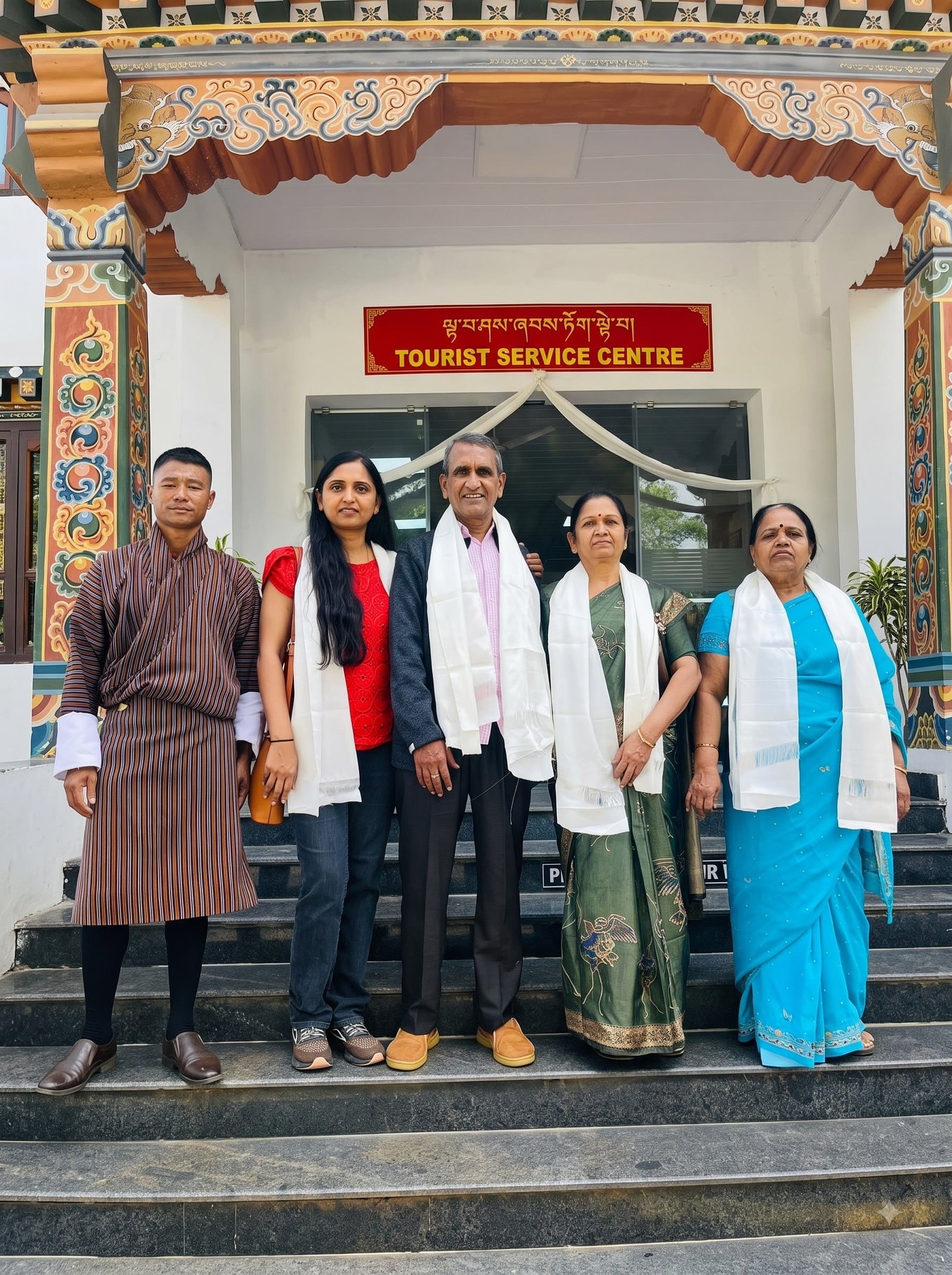
Most families don't choose a hotel category because they love star ratings. They choose it after one bad night. A cramped room where the extra bed blocks the bathroom door, a heater that works in the lobby and nowhere else, a restaurant that closes at the exact hour a tired six-year-old needs dinner: small things like these quietly decide whether a holiday is remembered fondly or merely survived.
Bhutan rewards families who plan around that. Days here involve mountain roads, thin air and a fair amount of walking to temples, so the hotel is not just where you sleep; it is where the whole group resets at three in the afternoon. That is the real case for a Bhutan 4 star family tour, and it is what this guide is built around: what the grade changes and what it doesn't, how to organise rooms for different family shapes, and three itineraries paced so nobody is hauled between valleys on a tight clock.
You won't find a rate card here on purpose. What a trip comes to depends on the month, the number of rooms, the ages of the children and the exact hotels chosen, so a written quote built around your family is far more reliable than a number guessed from a generic page.
The short answer
A Bhutan 4 star family tour is a private, guided Bhutan trip where the whole family stays in 4-star category hotels, with the guide, car, permits, government fee and breakfast-and-dinner meal plan bundled in. Most families choose five, seven or nine nights across Paro, Thimphu and Punakha, adding Phobjikha on the longest route.
- Hotel grade
- 4-star category; best-available comfort-grade stay in remote valleys
- Typical length
- 5, 7 or 9 nights
- Core route
- Paro, Thimphu and Punakha; Phobjikha on the longest route
- Bundled in
- Guide, private car, permits, government fee, hotels, breakfast and dinner
- Not bundled
- Lunch, entrance fees, airfare and personal expenses
- Entry for Indian nationals
- No visa; Entry Permit for all, Route Permit beyond Thimphu and Paro
- Children
- Fee concession for ages six to twelve; exempt under six
- Best months
- March, April, October and November
- Time difference
- Bhutan is 30 minutes ahead of Indian Standard Time
Why Families Choose a 4-Star Stay in Bhutan
Bhutan's guided-trip structure already removes most of the stress that makes family travel exhausting. A guide and driver stay with you, there is no public transport to juggle with luggage and children, and traffic is light even in the capital. Where families still feel a difference is at the end of the day. After a morning at a dzong and a winding drive, three things matter more than the view from the lobby: space, warmth and food.
Space to spread out
Rooms in 4-star hotels tend to be noticeably larger than in the 3-star band, which matters when four people share a room with suitcases, school bags and a pile of drying jackets. An extra bed fits without turning the room into an obstacle course, and there is usually somewhere to sit that isn't the edge of a bed.
Warmth when the valley turns cold
Paro and Thimphu sit above 2,000 metres, and evenings turn cool well outside winter. In-room heating is usually a standard feature at this grade, and it is the detail that makes the biggest difference for grandparents and for babies. Ask about corridors and dining rooms too, since a warm bedroom doesn't help much if breakfast is eaten in a cold hall.
Food that suits more than one palate
A 4-star hotel generally runs a full restaurant rather than a fixed set menu, which makes vegetarian, no-onion-no-garlic and plain-rice-and-dal-for-a-fussy-eater requests far easier to handle. Because most family packages run on a breakfast-and-dinner plan, this is where half your meals happen.
None of this is automatic. The star grade is a bracket, not a promise: two 4-star hotels can differ a great deal in room layout, lift access and how well they are heated. That is why the booking questions further down this page matter more than the star count itself.
What "4-Star" Actually Means in Bhutan
Bhutan's tourism authorities grade tourist hotels by star category, and the grading has been revised from time to time, so the useful way to read "4-star" is as a comfort bracket rather than a fixed checklist. Within that bracket, expect a professionally run property with a restaurant, daily housekeeping, hot water in the rooms and staff used to hosting guests who arrive on tour programmes.
Where the label stretches is geography. Paro, Thimphu and Punakha have the deepest choice of hotels at this level. Further out, in valleys such as Phobjikha, there are fewer hotels in total, so what your operator books there is the best comfort-grade property available for your dates, which may or may not carry an identical grade on paper. A straight-talking operator tells you this up front and names the hotel instead of repeating "4-star" on every line of the quote.
"A 4-star hotel in Punakha" is a category. "This hotel, these dates, this room type" is a booking. Ask for the second one in writing.
3-Star, 4-Star and Luxury Lodges: What Changes for a Family
The comparison below shows general patterns, not promises about any individual hotel. It is meant to show where a family usually feels the difference, so you can judge where extra comfort is actually worth paying attention to.
| What a family notices | 3-star | 4-star | Luxury lodge |
|---|---|---|---|
| Room space | Compact rooms; an extra bed fits tightly | Noticeably larger; an extra bed or sofa bed usually fits comfortably | Spacious suites or villas with the most room per family |
| Family set-ups | Adjoining rooms depend on the property | Family, triple and adjoining rooms more commonly offered; still worth requesting early | Suites and villas in limited numbers |
| Cold-weather comfort | Basic heating; warmth varies by hotel | In-room heating usually standard; ask about corridors and the dining room | Well heated, with comfort designed in |
| Dining | Simpler menus with fewer choices | Restaurant on site; easier to arrange vegetarian and children's meals | Chef-led, set menus; dietary needs pre-ordered |
| Access for older guests | Often stairs only | Lifts in many larger properties; ground-floor rooms can be requested | Varies; scattered villas can mean long walks |
| Setting | Usually in or near town | Town-edge or valley-view locations with a garden, lounge or spa on many properties | Often secluded, a drive from the nearest town |
Patterns vary by hotel and season. Treat this table as a conversation starter with your operator rather than a specification.
For most families the 4-star bracket is the sensible middle: enough extra space and warmth to make evenings easy, without the seclusion of remote lodges where the nearest town is a drive away. If your plans lean towards the top end, the separate Bhutan luxury travel guide covers that side of the market, and the 7-day 4-star itinerary looks at a single week in more detail for couples and small groups.
Room Planner: Matching Rooms to Your Family's Shape
Room layout is where a family trip is won or lost, and it is the question operators are asked least often. Here is how the common family shapes usually work out at a 4-star hotel.
Family or triple room, or a double with an extra bed
Ask what kind of extra bed it is. A proper bed rather than a folding mattress makes a real difference to a school-age child over several nights.
Two adjoining rooms, or one large family room
Adjoining rooms keep everyone close and give teenagers a door of their own. One big room suits younger children who still want a parent in sight.
Two or three rooms on the same floor
Aim for at least one connected pair and avoid being split across wings or floors, which turns every bedtime into a relay.
Ground floor or lift access for grandparents, adjoining rooms for the rest
Keep grandparents near the lift or on the ground floor, away from stairs and busy corridors, with the family close enough to knock.
A cot requested in advance
Tell the hotel about the cot, warm water and feeding needs before arrival. Cots are far easier to arrange when the hotel has been told early.
Connecting rooms are limited in number at most hotels and go first in busy months, so request them as soon as your dates are fixed rather than a week before departure.
Reaching Bhutan With Children or Older Parents
Both entry points lead into the same tour, and your guide and driver meet you either way. For a family, though, the choice matters more than it does for a solo traveller.
Ways into Bhutan, for a family group
Bar length shows how gentle each option is on a group with young children or older relatives
Shortest total travel time and the better pick whenever a baby, toddler or grandparent is travelling. Paro's airport operates in daylight only and weather can rearrange schedules, which is one reason the itineraries below put the final night back in Paro instead of in a faraway valley.
Practical for families already travelling through North Bengal, Sikkim or Assam. Phuentsholing to Thimphu alone is five to six hours on the road, so this suits older children better than infants.
Bhutan runs half an hour ahead of Indian Standard Time, a small thing that confuses nobody for more than a day but is worth telling the children so they don't think their watches are broken. Whichever route you take, keep the first evening free of plans. Altitude and a long travel day are a poor mix with sightseeing.
Three Bhutan 4 Star Family Tour Itineraries, Compared
These three routes are built around how far a family can comfortably travel between hotels, not around ticking off places. Each one finishes with a night back in Paro, so the flight home isn't staked on a long morning drive. Every one can be reshaped once your operator knows ages, dates and how many rooms you need. If you are also weighing other lengths, the main Bhutan family tour packages guide sets out a wider range.

Comfort Capital Break
Short & Comfortable5 Nights / 6 Days · Paro · Thimphu · Paro
- A calm start with nothing scheduled on the first evening
- Tiger's Nest taken to whatever height suits the group
- Two unhurried nights in Thimphu rather than one rushed day
- Final night in Paro, so the flight home is not a morning dash
Best for: families with young children, or anyone testing a 4-star Bhutan trip over a short break before committing to more nights.
See the day-by-day plan

Western Valleys Family Stay
Balanced7 Nights / 8 Days · Paro · Thimphu · Punakha · Paro
- Adds Punakha, the warmest valley of the trip and a favourite with children
- Dochula Pass and an easy rice-field walk to Chimi Lhakhang
- Two nights in Punakha, so nobody is packing the morning after arriving
- The longest drive is split with a lunch break in Thimphu
Best for: first-time family travellers with school-age children, and groups with grandparents who want a slower version of the western circuit.
See the day-by-day plan

Grand Family Circuit
Unhurried9 Nights / 10 Days · Paro · Thimphu · Punakha · Phobjikha
- Phobjikha's wide glacial valley gives the middle of the trip a slower, quieter feel
- Open afternoons in both Punakha and Phobjikha for rest or free time
- Thimphu is split across two short stays, so each drive stays manageable
- Black-necked cranes winter in the valley from late October into the cooler months
Best for: teenagers, repeat visitors and three-generation groups who would rather have more nights and gentler days than a tight schedule.
See the day-by-day plan
What a Typical Day Looks Like
Sightseeing days follow a gentle rhythm designed around the hotel as a midday base. Times flex with the season and with whoever sets the pace, which is usually the youngest or the oldest member of the group.
- Around 8:00Breakfast at the hotelNo alarm-clock starts. Most 4-star hotels serve a proper buffet, which suits fussy eaters and early risers alike.
- Around 9:00Out with guide and driverOne main sight and one short stop in the morning. Two big monuments back to back is where children (and grandparents) wilt.
- Around 1:00Lunch on the roadLunch is not part of the hotel meal plan, so it is eaten at a local restaurant between sights. Carry snacks for the car.
- Around 3:00Back at the hotel to resetA nap, a shower, time in the garden or lounge. This midday pause is the quiet advantage of a comfortable base.
- Around 4:30A light second outingA short walk, a market stroll or an archery match. Optional, and the first thing to drop if the group is tired.
- Around 7:30Dinner at the hotelPart of the breakfast-and-dinner plan. Request children's portions and any vegetarian preferences when you check in.
Adjusting the Trip by Age
Share exact ages with your operator and the same itinerary can be rebuilt around whoever is in the car. Here is what usually changes, and where a 4-star stay helps.
Babies, Toddlers and Preschoolers
Cot or extra bed arranged in advance, short drives, and no obligation to hike. Mention feeding needs to the hotel; most can provide warm water and simple meals.
Primary-School Children
A mix of hands-on stops such as the takin preserve, archery and a farmhouse visit alongside temples, with the full Tiger's Nest hike left optional.
Teenagers
Full hikes, seasonal rafting in Punakha and walking-focused stops. Many prefer an adjoining room of their own, which a 4-star hotel is better placed to offer.
Grandparents and Seniors
Ground-floor or lift-access rooms, later starts, shorter walks, and a spare night before any high pass. Warm rooms and adjustable meals help most.
Family Favourites Along the Route
A handful of stops come up again and again when families look back on a trip. None of them needs a long walk, and most work for several ages at once.
Takin preserve, Thimphu
A relaxed stop where Bhutan's national animal can often be seen up close, usually a hit with younger children.
Dochula Pass
Tea, mountain views on clear days and 108 memorial stupas, all without a single step of climbing.
Chimi Lhakhang walk
A gentle stroll across paddy fields from the road, with village life along the way.
Punakha suspension bridge
A long bridge above the river that children tend to want to cross twice.
Phobjikha's crane valley
A wide, flat valley with an easy trail and, in the cooler months, wintering black-necked cranes.
Archery and farmhouse visits
Bhutan's national sport and a home-style lunch or hot stone bath, two of the most reliably popular extras.
What's Included in a Bhutan 4 Star Family Tour
The guide, car, permits and government fee are part of the package, not optional add-ons. What is genuinely worth confirming for a family booking is the room configuration, what the meal plan covers for children, and whether the itinerary has really been paced for your group rather than just relabelled.
Inclusions
- Stay in 4-star category hotels, with connecting or adjoining rooms requested where available (best-available comfort-grade property in remote valleys)
- English-speaking guide, briefed on the group's ages and pace
- Private, family-sized vehicle with driver
- Driver allowance and parking fees
- Airport or border pick-up and drop-off for the whole family
- Sustainable Development Fee, with child concessions applied automatically
- Entry Permit and Route Permits for every family member
- MAP meal plan (breakfast and dinner), with children's menu requests
- Complimentary SIM card and mineral water per room
Exclusions
- All entrance fees and monument fees
- Personal expenses
- Airfare or train tickets
- Lunch
- Any expenses arising from unforeseen circumstances such as landslides or flight delays
Permits, Documents and the Child Concession
Indian nationals don't need a Bhutan visa, but there is still a short paperwork trail for every member of the group, children included. The detail that catches first-time families out is that the standard Entry Permit covers Thimphu and Paro only, so anything beyond needs a second document. The Sustainable Development Fee also carries a concession for children aged six to twelve, and children under six are exempt; your operator applies this while arranging the permits.
- Valid photo ID for every adult: A passport with six months' validity, or a voter ID card for adult Indian nationals.
- Passport or birth certificate for each child: Either is accepted for children travelling with parents; carry the original, not a photocopy.
- Entry Permit for the whole family: Free, and arranged as one group booking by your operator once the package and travel dates are confirmed.
- Route Permit for onward destinations: A second, also free, permit needed as a group for Punakha, Phobjikha and other places beyond Thimphu and Paro.
- Passport-size photographs: A couple of spares per family member, in case a physical form is needed at a border crossing.
- Basic medical kit and regular medication: Worth packing for children and older travellers, given the altitude and the mountain roads.
- Travel insurance for the whole family: Not mandatory for Indian nationals but sensible, particularly with infants or grandparents along.
Confirm that the Route Permit covers every family member, children included, before you leave home. It is the item people forget to ask about, and the easiest to fix in advance.
Best Months for a Bhutan 4 Star Family Tour
Two calendars matter: Bhutan's own weather and festival rhythm, and the school holiday windows most Indian families plan around. The chart below weighs both, with a note on how hard it tends to be to get the rooms you want.
Family comfort by month
A planning guide, not measured data: weighted for mild weather, open roads and typical school-holiday windows
October is the standout month, with festival season and the clearest mountain views, though it is also when 4-star rooms in Paro and Thimphu fill earliest. April is a strong second choice for spring dates. March and November are quieter and still comfortable, and November has the added draw of black-necked cranes arriving in Phobjikha, which makes the nine-night route especially rewarding then. Winter works well for families who are happy with crisp, cold days, provided the rooms are properly heated.

Eight Questions to Ask Before You Book a 4-Star Family Stay
These turn a hotel category into a confirmed booking. A good operator will answer every one without hesitation.
- Which exact hotel will we stay in each night? Ask for names and dates in writing, not just a category, and for the grade each hotel carries.
- What is the room set-up for our group? Family room, adjoining rooms or an extra bed, and what kind of extra bed it is.
- Is there a lift, or can we have lower-floor rooms? Essential if grandparents or toddlers are travelling, and many hotels have stairs only.
- How are the rooms and dining area heated? A warm bedroom helps little if breakfast is in a cold hall, so ask about both in the cooler months.
- How are children's, vegetarian and Jain meals handled? Confirm at booking and again at check-in. Remember that lunch is outside the hotel meal plan.
- What are check-in and check-out times against our flights? Ask whether an early check-in or a late departure room is possible after a morning arrival.
- Is the hotel walkable from town, or car-dependent? A hotel on a hillside with a lovely view can also mean a drive for every evening stroll.
- What happens if a hotel is full? A good operator names the substitute and promises an equal or better grade in writing.
How to Plan a Bhutan 4 Star Family Tour, Step by Step
- Fix your dates and list every traveller's age. Group size alone is not enough. A two-year-old and a twelve-year-old need different pacing even on the same itinerary, so share exact ages with your operator from the start.
- Choose the number of nights before the places. Five nights suits Paro and Thimphu, seven adds Punakha, and nine adds Phobjikha. Let the slowest traveller decide, not the most ambitious one.
- Match the route to the slowest traveller. If a grandparent finds long drives tiring, favour routes that return to Paro early. If the children are small, keep each hotel for at least two nights.
- Describe exactly how you want to sleep. Say whether you need adjoining rooms, a cot, lower floors or lift access. Popular hotels in Paro and Thimphu run out of these set-ups first in festival season.
- Get hotel names and room types in writing. Confirm the hotel for each night, the room type, the meal plan and what happens if a property is full.
- Arrange permits for every traveller. Your operator applies for Entry and Route Permits together. Check that children are on the list, and carry original IDs.
- Pack for mountain roads and thin air. Layers for cool evenings, motion-sickness remedies for winding drives, a few days of regular medication, snacks for the car and sun protection even on cloudy days.
Frequently Asked Questions: Bhutan 4 Star Family Tour
What is a Bhutan 4 star family tour?
It is a private, guided Bhutan trip for a family or multi-generation group in which the hotel stays are in the 4-star category. The guide, private car, permits, government fee and breakfast-and-dinner meal plan come bundled in, and the itinerary is paced around the youngest and oldest travellers.
Are 4-star hotels available in every part of Bhutan?
Mostly in the main western towns. Paro, Thimphu and Punakha have the widest choice. In smaller valleys such as Phobjikha there are fewer hotels, so your operator books the best comfort-grade property available and should tell you its name and grade in advance.
Is a 4-star hotel worth it for a family compared with a 3-star?
For most families the extra space, heating and restaurant choice are what make the difference, particularly with young children or grandparents. A 3-star hotel can be perfectly good for a short trip, but rooms are usually tighter, which is felt most when four or more people share.
Can we get connecting or adjoining rooms at a 4-star hotel?
Often, but not at every hotel, and the number is limited. Ask as soon as your dates are fixed, since connecting rooms are among the first to go in October and April. If none are free, rooms on the same floor are the next best option.
How many nights should a family plan for a 4-star Bhutan trip?
Five nights covers Paro and Thimphu comfortably, seven adds Punakha, and nine suits families who want Phobjikha as well or who simply prefer shorter drives and extra rest time.
Do children need permits, and is there a fee concession?
Yes, every family member needs an Entry Permit and, for destinations beyond Thimphu and Paro, a Route Permit. Children travel on a passport or birth certificate. The Sustainable Development Fee has a concession for children aged six to twelve, and children under six are exempt; your operator applies it while arranging the permits.
Is this kind of tour suitable for grandparents?
Yes, with the right choices: ground-floor or lift-access rooms, later starts, shorter walks and a spare night before any high pass. A 4-star stay helps because rooms are warmer and meals are easier to adjust.
Which months are best for a Bhutan 4 star family tour?
March, April, October and November are the most comfortable for most families. October brings festivals and the busiest bookings, while winter suits families happy with cold, clear weather and well-heated rooms. July and August are wet and best avoided if your dates allow.
Are vegetarian and Jain meals manageable at 4-star hotels?
Vegetarian meals are easy to arrange at hotel restaurants. Jain or no-onion-no-garlic requests are possible with notice, so tell your operator before travel and remind the hotel at check-in. Lunches outside the hotel are more limited, so carry snacks.
Will altitude affect children?
Paro and Thimphu sit at roughly 2,200 to 2,300 metres, which most children and adults adjust to within a day. A light first evening, regular water and a slow pace on the first hike are usually enough. Anyone with a heart or lung condition should check with a doctor first.
How do Indian families reach Bhutan for this trip?
By air into Paro from Delhi, Kolkata, Guwahati or Bagdogra, or by road through Phuentsholing, Gelephu or Samdrup Jongkhar. Flying is usually easier with babies and older relatives.
Ready to Plan Your Bhutan 4 Star Family Tour?
Share your travel dates, the ages travelling and how many nights you would like, and a travel designer will match you to an itinerary paced for your family, with named hotels and a transparent written quote.